
Gigi Langer

Worry Less Now!

 Love More Now!

IF YOU’RE ON A HUNT FOR HAPPINESS, YOUR THOUGHTS CAN’T SCARE YOU!

hunt for happiness gigi langer

We just finished “Hunt for Happiness Week,” and I wanted to share with you my favorite tool for dissolving the worries and negativity that block our happiness.

Stress is not a reaction to an event but rather to how you interpret the event.” (Sonya Collins)

How can you change the meaning you’re giving to the things that bother you? One method is to question your thoughts about the troubling situation. Chances are, you’re seeing it in a very scary way. But that CAN be changed!

One of the things that recently caused me distress concerned Judymy dear friend and business partner for over twenty yearswho was diagnosed with breast cancer. In between her chemotherapy and multiple surgeries, she continued to work at her usual hectic pace. I was terrified Judy would get sick again, and I didn’t want to lose her.

My worried mind whispered to me, “She should not work so much,” and it interfered with my hunt for happiness. Soon after admitting this, I began to seek a new way of looking at the situation.

Just in time, a friend invited me to attend a weekend course with Byron Katie, the developer of “The Work”—an amazingly powerful tool for examining and reframing our minds’ negative interpretations.

Tool Number 6. Is It True? [from 50 Ways to Worry Less Now]

Byron Katie gave me permission to use this illustration of her process. My responses to her recommended questions appear in italics.

  1. Write in your journal about a particularly troubling situation in your life. What’s wrong? What should be different? I am so worried about Judy. She’s had cancer, and she’s determined to work long hours even as she’s recovering from surgery and chemotherapy. I’m terrified her ambitious work schedule will make her sick again. Nothing I say or do has changed the situation. I feel stuck
  2. Select one thought to explore in greater depth. Write it at the top of a new page. Judy should not overwork.
  3.  Ask yourself, Is this true?  Yes.
  4. Ask yourself, Can I absolutely know it’s true? No, probably not . . . there might be times when it’s ok.
  5. Ask yourself, How do I react when I believe this thought?    I worry about Judy. I react by trying to do things for her. I judge her as not being able to take care of herself. I’m thinking about this way too much, and it’s robbing my peace of mind.
  6. Ask yourself, Who could I be if I didn’t believe this thought? What might my life look like or feel like?   Without this thought, I’d be more accepting of how Judy is dealing with her illness. I could stop worrying about her and meddling in her life. I could relax.
  7. What other ways of saying the original statement might be as true, or truer, than the original thought? (Original statement: Judy should not overwork.) (a) Turn the thought around to the opposite:  Judy should overwork.  In what way is this as true, or truer, than your original statement?   She realizes every minute is precious and she has a lot she wants to do. (b) Turn the thought around to yourselfI should not overwork.  In what way is this as true, or truer, than your original statement?      I’ve been working too much and I’m under a lot of stress. I need to take better care of myself.

The point of this exercise is to see that the meaning you’ve constructed is not necessarily the truth. In my case, I was afraid Judy would get sick again, and I thought she would stay healthy if she worked less. When I turned it around to the opposite, however, I saw that the decision was Judy’s to make and not mine, that working might be exactly what she needed.

As I turned it around to myself, I got a big dose of honesty. I realized my true concern needed to be with my own overwork. As so often happens, when we point an accusing finger at another, we find three other fingers pointing back at us. This insight prompted me to face my own whispered lie that if I didn’t work hard enough I would fail at my job. I had been worried about looking weak or imperfect, a hangover from my zero-sum-game days.

Whenever we detect false beliefs interfering with our serenity, it’s time to take a breath and acknowledge the scary unpredictability of life. Then we can use any of the 50 tools in “Worry Less Now” to face our challenges with courage and grace. 

If your hunt for happiness is thwarted by negative thoughts, try the “Is It True?” exercise. Be sure to select one of the damaging beliefs you’re holding about another person, and go through each step with it. You might be amazed!

gigi langer worry less now

Gigi Langer, PhD.  Many years ago, I used alcohol, romance, and professional accomplishments to soothe my frayed nerves. Over time, I discovered effective tools from therapy, recovery pro­grams, scientific research, energy work, and a variety of philosophical and spiritual teachings. I share those techniques in my blog and book so you can find peace of mind and wisdom, no matter what is bothering you.
worry less now

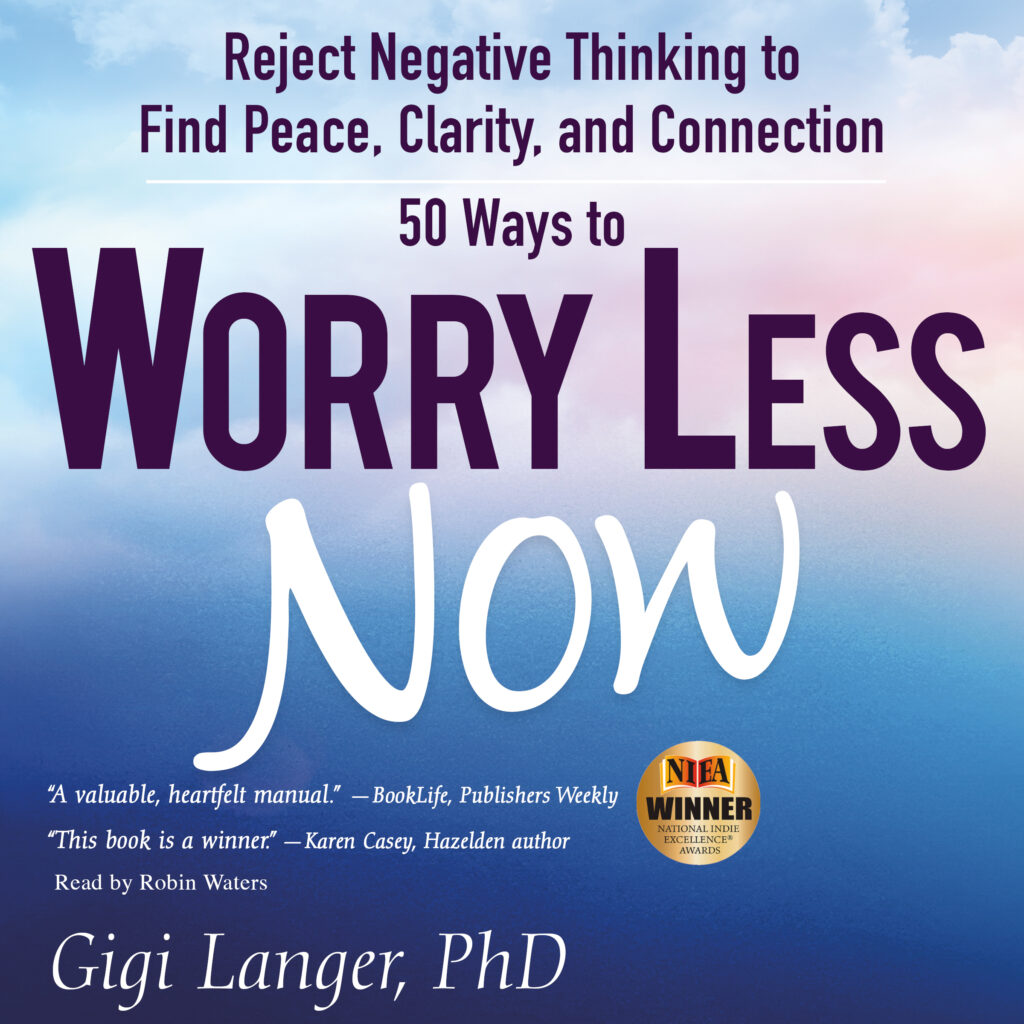
My award-winning book, 50 Ways to Worry Less Now, describes how I and others have defeated the faulty thinking leading to dysfunctional relationships, perfectionism, addiction, and worry about loved ones. Gain practical strategies through personal stories. Amazon: 4.8 stars (53 reviews) (Buy Paperback, e-book, OR audiobook HERE

REVIEWS:  Karen Casey, best-selling author of Each Day a New Beginning (Hazelden) “Even though I have been in recovery for more than 4 decades, and didn’t think another self-help book would make it to my treasured list, I was wrong. This book is a winner.” 

Anonymous Reader: “Your Book certainly transformed my life!  All I can say is, THANK YOU A MILLION TIMES OVER” 

Honesty Will Set You Free, But Denial Won’t

Lying to ourselves is more deeply ingrained than lying to others.” Dostoevsky

What secrets have you been keeping from yourself? Perhaps you’re worried about your own well-being or a loved one’s overworking, drinking, or depression. Even though these worries occasionally get your attention, when they die down again, they’re easy to forget. But that would be a mistake if you really want to be free.

The Truth Will Set You Free

The foundation of much unhappiness is denial, a coping mechanism that allows a person to reject a painful truth too uncomfortable to accept. Denial’s voice emphatically whispers, “I don’t want to admit the truth; and if I did, I just couldn’t handle it.”

As the saying goes, “We’re only as sick as our secrets.” All the concerns listed above, as well as overeating, sleeping too much, obsessing about politics, or trying to control loved ones, are the unhealthy distractions of people flirting with denial.

In spite of these defenses, the pain hiding underneath the secret emerges, perhaps in a burst of outrage or in a bothersome sense of unrest in the gut. Tight shoulders, jaw clenching, headaches, frequent illness, and a host of other complaints may be symptoms of stifled truths and feelings.

Denial and Blaming Keep Us Stuck

For many of us, denial has been protective, softening the blows of life with a cocoon of forgetting. But denial, when held onto for too long, can keep us from facing up to and learning from our experiences.

We humans have a great tendency to avoid responsibility for our part in a difficult situation. Imagine you’ve just had a heated argument with your partner. As you replay the incident, you think, “It’s not my fault,” “He should not have said that,” or “If only he would be more understanding.” While these statements might be partially true, this kind of blaming only keeps you stuck.

What if, instead of blaming him, you honestly considered your own part in the disagreement? For example, you might discover you’ve been demanding, moody, or critical. You could then do the work to overcome the false belief that your partner must be perfect. Eventually, you find yourself focusing on his strengths instead of his faults. Perhaps you learn to state your own needs as preferences rather than demands. Eventually, your relationship begins to grow and thrive.

Select one troubling area in your life and work through it using the strategies and tools I offer in “50 Ways to Worry Less Now.” [This excerpt is taken from Chapter 2, “Getting Honest about Your Worries.”] Get started now with this “Honesty Check-Up.”

Honesty Check-Up

Write about these questions (My own answers are below)

  1. What damaging aspects of your character (false beliefs) are you denying?
  2. How would your life be better without them?
  3. What is the cost of not dealing with them?
  4. What steps are you willing to take to free yourself from this pattern?
  1. My current false belief is “I’m  not working hard enough to help my book reach a lot of people.”
  2. Without this belief, I could be relaxed, calm, and fully present with my husband and friends. I would be more outgoing and positive.
  3. The costs of denying this belief are continued stress, stomach problems, not enjoying the present moment, and negative self-talk.
  4. I am meditating regularly, praying for a new way of seeing my book’s “success,” and will discuss my concerns with my spiritual advisor.
Gigi Langer Worry Less Now

Gigi Langera person in recovery, holds a Ph.D. in Psychological Studies in Education and an MA in Psychology from Stanford University. Through her writing, coaching, and speaking, Gigi has helped thousands of people improve their lives at home and at work. She lives in Michigan with her husband and Murphy, her cat.

worry less now

Get Gigi’s new book, “50 Ways to Worry Less Now: Reject Negative Thinking” is available in audio, e-book, and paperback (5 Stars on Amazon). Click HERE

“Valuable, heartfelt manual.” — Publishers Weekly (BookLife)

“This book is a winner.” -Karen Casey, Hazelden author

My 2020 Inventory: Don’t Hold Back!

“Searching within myself, I will patiently, trustingly share myself with others.”Karen Casey (Best-selling Hazelden author)

Back in the 80s, my favorite spiritual author, Karen Casey, wrote “Each Day a New Beginning” for women in recovery, and it has sustained me through these many years. The quote above is particularly relevant as I start this year. I now see clearly (20 20 vision, right?) a major way I’ve been resisting God’s will. Here’s a quick inventory of my tendency to hold back.

  • Recently, I realized I’ve never memorized the Step 7 prayer exactly as written. Soon after that, a stranger in a 12-step program gave me a card with the prayer on it. So, I started saying it.
  • I also noticed a creeping opposition to doing things I was called to do. Whispered lies crept into my mind: “Oh, that would be too much work.” “I just don’t feel like doing that.” “Haven’t I done enough?”
  • By resisting those nudges, I knew I was letting my self-will override God’s direction. So, I put a sticky note in my car: “Thy Will Be Done; Not Mine.” I see it many times a day.
  • Perhaps it’s been sinking in, because I now offer you my 4th & 5th step inventory: My fearful self has always told me to “Hold Back!” Hold back smiles to strangers. Hold back chats with neighbors. Hold back calling others on the phone. Hold back compliments, etc.
  • When I get the opportunity to do kind acts, I usually talk myself out of it. I tell myself I’m an introvert, or that I’m not good at “small talk,” or that I don’t have time.
  • But mostly it’s about (1) the false belief, “If I give love away, it might never return; there’s not enough to go around” and (2) fear of getting enmeshed, controlled, hurt, or inconvenienced. (Yup, I grew up in an alcoholic home.)
  • My 6th step character defects are self-will (pride) and fear (insecurity). In short, I’ve resisted God’s will to love and serve others; and  I haven’t trusted my Higher Power to keep me safe and secure.
  • I now say the 7th step prayer: “My Creator, I am now willing that you should have all of me, good and bad. I pray that you now remove from me every single defect of character which stands in the way of my usefulness to you and my fellows. Grant me strength as I go from here, to do your bidding.”  

Long ago I learned that God can supply every need, and that my worth and safety are established by my Higher Power. But, being human, I forget. In recovery, we learn that our happiness is dependent upon our spiritual condition. As Karen Casey wrote, “Sincerely touching the soul of someone else can tap the well of happiness within each of us.” That’s my plan for 2020!

Gigi Langer Worry Less Now

Gigi Langer, PhD.  Many years ago, I used alcohol, romance, and professional accomplishments to soothe my frayed nerves. Over time, I discovered effective tools from therapy, recovery pro­grams, scientific research, and a variety of philosophical and spiritual teachings. I share those techniques in my blog and book so you can find peace of mind and wisdom, no matter what is bothering you.

Worry Less Now Cover

My award-winning book, 50 Ways to Worry Less Now, describes how I and others have defeated the faulty thinking leading to dysfunctional relationships, perfectionism, addiction, and worry about loved ones. Gain practical strategies, personal stories, and guided activities. Amazon: 5 stars (51 reviews) (Buy Paperback, e-book, OR audiobook HERE)

REVIEWS:  Karen Casey, best-selling author of Each Day a New Beginning (Hazelden) “Even though I have been in recovery for more than 4 decades, and didn’t think another self-help book would make it to my treasured list, I was wrong. This book is a winner.” Anonymous Reader: “Your Book certainly transformed my life!  All I can say is, THANK YOU A MILLION TIMES OVER” 

SHRED YOUR NEGATIVITY—EVEN IN HOLIDAY TRAFFIC!

HERE’S A SITUATION SURE TO KICK OFF NEGATIVITY:  Imagine you’re on your way to an important doctor appointment and you’ve left just a little late. You find yourself waiting in a long line of cars with left-turn signals blinking.

When the cars finally begin to inch forward, you realize you might not make it through the light. You look at your watch, clench your jaw, and think, “I can’t miss this appointment.” Your stomach begins to churn as you imagine having to wait several more weeks to see the doctor.

Suddenly, a big black car cuts in front of you. He’s the last one to make it through the light. You bang your hands on the steering wheel and yell, “Who in the hell does he  think he is?” Then your mind whispers, “I’ll never get in to see the doctor! My symptoms will get worse and I’ll suffer even more. Why does this always happen to me?”

NEGATIVITY: THE CONSEQUENCES

It’s hard to keep such incidents from prompting a hissy fit, often with dire results. For instance, we might drive recklessly in the traffic or speak rudely to the doctor’s receptionist.

Or, when we arrive home, our frustration might cause us to hurt a loved one with critical or impatient words.

AN ALTERNATIVE APPROACH

I’ll bet you’ve had similar experiences, especially with holiday traffic. I sure have. But after years of working with my negative thinking, I’ve discovered how to change it through Honesty, Power, Choice, and Growth Tools. Here’s how it looks in the traffic situation.

First, the driver honestly admits how upset she is, and tunes into the tension in her jaw and belly. She then notices, without judgment, her negative thoughts—for example, “I just thought ‘That guy is a real jerk!’ and I’ve convinced myself I’ll never make it to my appointment.”

She follows that realization with “If I can stop worrying, I can access the power of clarity.” She then makes the choice to cease upsetting herself.

She might seek a different perspective by thinking, “I have no control over this traffic. This would be frustrating for anyone. I’m willing to trust that I’ll get to the doctor at just the right time.”

To move her focus away from her irritation and fear, she applies the following growth tools.

She begins with the tool of deep breathing. In her calmer state, she tries to feel compassion toward the driver who cut her off. Perhaps he’s had a bad day or family emergency.

Finally, she uses visualization to imagine the office  receptionist being helpful and kind. As her negative thinking continues to make a bid for her attention, she persists in using these tools.

In a short time, the next right action occurs to her. She thinks, “I’m  going to call the receptionist and ask if I can keep my appointment if I’m thirty minutes late.” When her call is put on hold, she breathes calmly.

Soon, she learns that the doctor is behind schedule and being late is no problem. She relaxes and enjoys the ride.

ISN’T THIS APPROACH PRETTY PASSIVE?

Perhaps you’re thinking that the driver should have been more assertive, perhaps by immediately seeking a detour.

*Here’s an important point: Using these strategies does not mean that you never take strong action.*

They simply allow you to delay acting until you’ve gained a little wisdom. As a result of your new perspective, if you are meant to do something, you’ll have the direction you need.

Unfortunately, we don’t have as much control over external events as we might imagine, and fretting or forcing a solution often just makes things worse.

Next time you’re irked by traffic, try applying honesty, power, choices, and growth tools. You can experience the peace and goodwill of the season, no matter what!!

Gigi Langer Gigi Langer, a Stanford PhD, is a former teacher who quit drinking, only to find that her negative thinking, judging, and fears kept her in a cycle of worry, codependency, chronic pain, perfectionism, and overworking. Her award-winning book “50 Ways to Worry Less Now” (Amazon 4.8 stars) is available in paper, e-book, and audiobook. Honest, practical, simple. Relevant to anyone! Buy it here GigiLanger.com/buy