
Gigi Langer

Worry Less Now!

 Love More Now!

IF YOU’RE ON A HUNT FOR HAPPINESS, YOUR THOUGHTS CAN’T SCARE YOU!

hunt for happiness gigi langer

We just finished “Hunt for Happiness Week,” and I wanted to share with you my favorite tool for dissolving the worries and negativity that block our happiness.

Stress is not a reaction to an event but rather to how you interpret the event.” (Sonya Collins)

How can you change the meaning you’re giving to the things that bother you? One method is to question your thoughts about the troubling situation. Chances are, you’re seeing it in a very scary way. But that CAN be changed!

One of the things that recently caused me distress concerned Judymy dear friend and business partner for over twenty yearswho was diagnosed with breast cancer. In between her chemotherapy and multiple surgeries, she continued to work at her usual hectic pace. I was terrified Judy would get sick again, and I didn’t want to lose her.

My worried mind whispered to me, “She should not work so much,” and it interfered with my hunt for happiness. Soon after admitting this, I began to seek a new way of looking at the situation.

Just in time, a friend invited me to attend a weekend course with Byron Katie, the developer of “The Work”—an amazingly powerful tool for examining and reframing our minds’ negative interpretations.

Tool Number 6. Is It True? [from 50 Ways to Worry Less Now]

Byron Katie gave me permission to use this illustration of her process. My responses to her recommended questions appear in italics.

  1. Write in your journal about a particularly troubling situation in your life. What’s wrong? What should be different? I am so worried about Judy. She’s had cancer, and she’s determined to work long hours even as she’s recovering from surgery and chemotherapy. I’m terrified her ambitious work schedule will make her sick again. Nothing I say or do has changed the situation. I feel stuck
  2. Select one thought to explore in greater depth. Write it at the top of a new page. Judy should not overwork.
  3.  Ask yourself, Is this true?  Yes.
  4. Ask yourself, Can I absolutely know it’s true? No, probably not . . . there might be times when it’s ok.
  5. Ask yourself, How do I react when I believe this thought?    I worry about Judy. I react by trying to do things for her. I judge her as not being able to take care of herself. I’m thinking about this way too much, and it’s robbing my peace of mind.
  6. Ask yourself, Who could I be if I didn’t believe this thought? What might my life look like or feel like?   Without this thought, I’d be more accepting of how Judy is dealing with her illness. I could stop worrying about her and meddling in her life. I could relax.
  7. What other ways of saying the original statement might be as true, or truer, than the original thought? (Original statement: Judy should not overwork.) (a) Turn the thought around to the opposite:  Judy should overwork.  In what way is this as true, or truer, than your original statement?   She realizes every minute is precious and she has a lot she wants to do. (b) Turn the thought around to yourselfI should not overwork.  In what way is this as true, or truer, than your original statement?      I’ve been working too much and I’m under a lot of stress. I need to take better care of myself.

The point of this exercise is to see that the meaning you’ve constructed is not necessarily the truth. In my case, I was afraid Judy would get sick again, and I thought she would stay healthy if she worked less. When I turned it around to the opposite, however, I saw that the decision was Judy’s to make and not mine, that working might be exactly what she needed.

As I turned it around to myself, I got a big dose of honesty. I realized my true concern needed to be with my own overwork. As so often happens, when we point an accusing finger at another, we find three other fingers pointing back at us. This insight prompted me to face my own whispered lie that if I didn’t work hard enough I would fail at my job. I had been worried about looking weak or imperfect, a hangover from my zero-sum-game days.

Whenever we detect false beliefs interfering with our serenity, it’s time to take a breath and acknowledge the scary unpredictability of life. Then we can use any of the 50 tools in “Worry Less Now” to face our challenges with courage and grace. 

If your hunt for happiness is thwarted by negative thoughts, try the “Is It True?” exercise. Be sure to select one of the damaging beliefs you’re holding about another person, and go through each step with it. You might be amazed!

gigi langer worry less now

Gigi Langer, PhD.  Many years ago, I used alcohol, romance, and professional accomplishments to soothe my frayed nerves. Over time, I discovered effective tools from therapy, recovery pro­grams, scientific research, energy work, and a variety of philosophical and spiritual teachings. I share those techniques in my blog and book so you can find peace of mind and wisdom, no matter what is bothering you.
worry less now

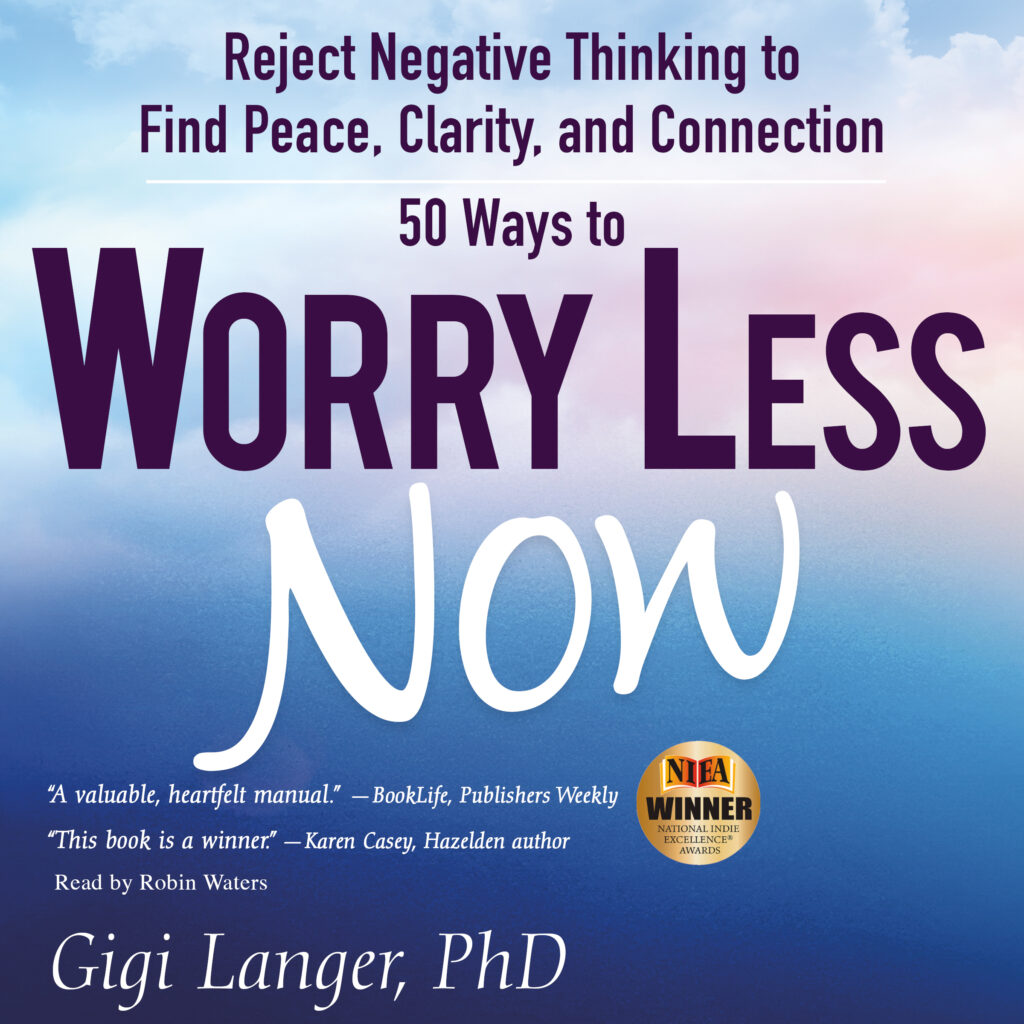
My award-winning book, 50 Ways to Worry Less Now, describes how I and others have defeated the faulty thinking leading to dysfunctional relationships, perfectionism, addiction, and worry about loved ones. Gain practical strategies through personal stories. Amazon: 4.8 stars (53 reviews) (Buy Paperback, e-book, OR audiobook HERE

REVIEWS:  Karen Casey, best-selling author of Each Day a New Beginning (Hazelden) “Even though I have been in recovery for more than 4 decades, and didn’t think another self-help book would make it to my treasured list, I was wrong. This book is a winner.” 

Anonymous Reader: “Your Book certainly transformed my life!  All I can say is, THANK YOU A MILLION TIMES OVER” 

FEELINGS ARE NOT FACTS!

DO YOU HAVE FEELINGS THAT JUST CARRY YOU AWAY AND COLOR YOUR WHOLE WORLD GRAY? Don’t worry! Such feelings are often created by fearful thoughts that aren’t even true.

For example, we live in the wreckage of our future (“Its going to be awful!”) or we create “unenforceable rules” (“This should (or should not happen”). Often, we try to change the past by thinking how it “could have” been better.

Such thoughts are driven by the fear-driven belief that, if we just think long and hard enough, we can protect ourselves (and our loved ones) from pain and harm.

SO, HERE’S THE TRUTH: We don’t have the means to make people and things exactly as we want them. We just aren’t that powerful.

AND, HERE’S THE GOOD NEWS: We can find peace of mind and contentment in the midst of our fearful feelings and thoughts. Why? BECAUSE WE CAN CHOOSE WHAT FILLS OUR MIND.

HOW? Meditation, walks outside, stretching, yoga, prayer, reading or watching inspiring books/movies, spiritual practices, energy work, and thought-correction can all soothe our most difficult feelings. Good healthy friends or counselors really help too.

When we get still and listen to our inner wisdom (or that of another), we receive the comfort of ACCEPTANCE (non-attachment to specific outcomes). Further, we find ways to address those problems that still bother us—IF they are still bothering us (quite often, they’ve shrunken down to nothing!).

NEXT TIME YOUR FEELINGS are having a hissy fit, stand apart from them for a moment to recognize they’re mostly a result of inaccurate and disturbing thoughts. Then, ask yourself, “What healthy actions can I take to soothe my mind and body?” And then, do that!

PLEASE SHARE YOUR FAVORITE WAYS OF SOOTHING UPSET FEELINGS IN THE COMMENTS SECTION. THANKS!!

Worry Less Now; Gigi Langer

Gigi Langer, PhD. Many years ago, I used alcohol, romance, and professional accomplishments to soothe my frayed nerves. When I quit drinking, I was left with only my fears and worries. Over time, I discovered effective tools from therapy, recovery pro­grams, scientific research, and a variety of philosophical and spiritual teachings.

My award-winning book, 50 Ways to Worry Less Now describes how I and others have defeated the faulty thinking leading to dysfunctional relationships, perfectionism, addiction, and worry about loved ones. It contains practical strategies with directions, personal stories, and other helpful suggestions. Amazon: 4.8 stars (48 reviews) (Buy Paperback, e-book, OR audiobook HERE)

Karen Casey, best-selling author of Each Day a New Beginning (Hazelden) “Even though I have been in recovery for more than 4 decades, and didn’t think another self-help book would make it to my treasured list, I was wrong. This book is a winner.”

7 Tips to Stop the Nasty Voice in Your Head

Do you have a voice in your head that incessantly whispers lies of impending doom or replays past events in the hope of changing them?

It might sound like this: “I always…(fail, am rejected, sabotage my success)” OR “If only he or she would (fill in the blank), we would all be okay.“

Although I used to hear this voice often, over the years I’ve learned to turn such negative thoughts into positive ones. Here are a few tips that might help you do the same.

  1. Notice how the voice in your head causes tension in your body and perhaps emotions of anger, pain, frustration, envy, or a need for security, recognition or love.
  2. Stand apart from the thoughts and feelings, as if you’re on a balcony observing them. Do NOT condemn them.
  3. Breathe slowly and deeply until your body calms down. Withdraw your attention from your worrying and focus on your breathing.
  4. Recognize who is watching the thoughts. It’s a part of your mind independent of your thoughts and emotions. This is your true self (higher self, God-mind, etc). It is greater, stronger, and wiser than the imagined disturbances.
  5. Make a choice: Do you want to stay in the drama of the fear-filled voices in your head, or do you want to experience peace and happiness?
  6. Write your mind’s false messages in a journal. Notice that many of them predict one of two horrible things: 1) past pain will repeat itself, or 2) the future will be disastrous. KNOW THAT NONE OF THESE IS TRUE.
  7. Dissolve your mind’s lies by using meditation, affirmations, prayer, therapy, yoga, inspirational reading, groups, energy work, or any other method to connect with the goodness and light of your true self.

As you refuse to believe the fearful voice in your head, sooner or later the answers to your troubles will appear in the most amazing way and for the best of all involved.

HOW DO YOU CALM YOUR OWN NEGATIVE THOUGHTS? I’d love to hear from you!

GIGI LANGER is the former “Queen of Worry” whose award-winning book, 50 Ways to Worry Less Now, rates 4.7 stars on Amazon. She holds a PhD from Stanford University in Psychology in Education.

HOW TO REJECT “Worry, Worry, Worry . . .”

worrying dog

This darling commercial features a dog who buried his bone, and then worried so much about its safety, he couldn’t leave it alone. The soundtrack is “Worry, worry, worry” from the Ray LaMontagne song, “Trouble”. Here’s the link.

DO YOU SOMETIMES FEEL LIKE THIS POOR, WORRIED LITTLE DOG?

More than 20 percent of us struggle with anxiety. On average, we spend about 300 minutes a day worrying, a condition linked with cardiac, emotional, and other health problems.

Worries tell us, “Watch out!” Sometimes, they rightly signal danger. But, what about those unfounded fears that sap our energy and lead to failure, discouragement, and limitation?

THE PROBLEM: OUR THINKING

I call such worries “whispered lies” because they’re mostly false, telling us the pain of our past will repeat itself. For example, “I can’t do this. I’ll fail!” “I don’t deserve love,” or “I can’t be happy if (fill in the blank) happens.”

So, our thinking is the problem, right? But, wait a minute! Our thinking helps us reach important goals: jobs, degrees, repairs, trips, and so on. We set a goal and, if we just try hard enough, we get everything we want, right?

Unfortunately, this linear approach doesn’t always work: Our hearts are broken, we don’t receive a hoped-for promotion, or a loved one is seriously ill. We’re shocked to realize how little control we have over our own lives–and the lives of our loved ones. But we keep trying, right?

We become like that little white dog: We imagine we can fix our troubles by worrying about them. Or, we try to deny them through partying, working long hours, sexual preoccupation, or drugs and/or alcohol.

But these desperate strategies don’t work. The worrying and negativity just multiply, and we become more miserable than before.

WHATS THE SOLUTION?

We can change our faulty thinking by using four life strategies: 1) get honest, 2) claim positive power, 3) make healthy choices, and 4) consistently use growth tools.

If we get honest with ourselves and take responsibility for our own worries, we begin to see that only something bigger than our fears can overcome them–a source of positive power. We might call it Buddha, Courage, the Divine Spark, God, Great Spirit, Awareness, True Self, Universal Intelligence, or any name that works for us.

Next, we choose a new life (perhaps through affirmations and vision boards) and use growth tools to dissolve our whispered lies (e.g. meditation, prayer, energy work, cognitive reprogramming).

THE RESULT

We become expressions of peace (serenity to accept and wait), clarity (wisdom to know what to do and when) and connection (thriving, loving relationships)–no matter what happens in our lives.

To learn how these four life strategies can ease your own troubles, read my award-winning book, 50 Ways to Worry Less Now: Reject Negative Thinking to Find Peace, Clarity, and Connection (Amazon 4.7 stars) available here. (Audiobook due in September)

Worry Less Now

Gigi Langer holds a PhD from Stanford University and is the former “Queen of Worry.” She’s also an educator, a popular speaker, and a person in recovery who hasn’t had a drink or drug for over 33 years.